What Happened When We Restarted YouTube
Last month our YouTube channel was basically dormant.
We’d made films for years, but somewhere along the way publishing took over and our youtube channel became an archive of old documentaries, book films and bits of work sitting there while we got on with making books.
Then, towards the end of summer, something clicked. Why don’t we just restart YouTube? No song and dance, no epic strategy, no grand announcement. Just tidy the channel up, start making some films again and see what happens.
None of us at Soi suddenly decided we wanted to become YouTubers. It was more that there was already so much happening around Soi that felt worth showing: books being made, archives being opened up, artists coming in, printing experiments, book fairs, projects taking years to come together, and all the slightly messy stuff that sits behind the finished object. We realised we actually had quite a lot to share that went beyond the normal rhythm of social media, and YouTube started to feel like the right place for it.
We make books with artists, photographers, musicians, brands and people with interesting stories or archives, and one thing we’ve become increasingly aware of is that the process is often every bit as interesting as the book that eventually comes out of it. Sometimes more so.
So we started documenting more of that.
Within a few weeks, a channel that had been getting almost no daily traffic was suddenly being watched by thousands of people a day, but what interested us more was who seemed to be finding it. We were starting to reach people interested in the same things we were interested in: independent publishing, visual culture, archives, design, books and the slightly obsessive business of making things properly.
We’re still incredibly early into it. At the time of writing it has only been about five weeks since the restart, so this definitely isn’t a “we cracked YouTube” article. If anything, this is more of a we probably should have started doing this earlier article.
It’s about what happened when we began showing the work rather than only showing the finished result, what seems to be working, what definitely hasn’t, and why we are starting to think video can be genuinely useful for a small creative business trying to find the right audience.
The channel was basically asleep
We weren’t starting completely from zero. The channel had been around for years and had roughly 1,400 subscribers, mostly from older documentary films and other work we’d made previously, but in practical terms very little was happening.
At one point we were getting around 20 views a day. There was no publishing rhythm, no consistent format, no-one looked at it and, probably most importantly, no reason for anybody to come back regularly. We did briefly think about starting a completely new channel, wiping the slate clean and building something specifically around Soi, but the more we thought about it, the less sense that made. The older films were still part of who we were and, actually, they helped explain how we had arrived here. It also felt slightly ridiculous to throw away years of work simply because the company had evolved.
So instead of starting again, we restarted.
We stopped thinking of YouTube as promotion
The most obvious temptation is to treat YouTube like another marketing channel. New book coming out? Make a film about it. Going to a book fair? Film that. New project underway? Talk about that.
There is nothing particularly wrong with any of those things and it is something we’re trying to do more of anyway, but content like that gets boring very quickly because, realistically, nobody wakes up in the morning desperate to watch a company update from a small independent publisher they have never heard of.
The more useful shift was to stop asking, “What do we want to tell people?” and instead start asking, “What is actually interesting here?”
Sometimes the interesting thing really is the book, but sometimes it is the fact that the book took two years to make, or the archive sitting behind it, or an unusual production decision, a strange piece of printing, a designer, a photographer, a scene, a city or the reason somebody wanted to make the book in the first place.
Once we started thinking in those terms, the films we want to make change quite quickly.
Instead of simply saying that we had gone to an art book fair, the more interesting question became whether independent publishers can actually sell books at art book fairs. Instead of simply announcing that we were making a particular book, the story might be why it had taken two years to make, what had gone wrong along the way and why we were still doing it.
The subject had not really changed. The framing had.
And that is the biggest things we’re learning.
Showing the process seems to matter
Publishing is surprisingly good at hiding its own labour. You see a finished book in a shop, at a fair or online, but very little of what happened before it arrived there: the research, the emails, the design changes, the photographs that did not make the edit, the conversations around format, paper, binding and price, and sometimes months or years spent trying to turn a huge body of material into something that makes sense between two covers.
Showing more of that is something we’ll be doing more going forward.
It gives people a better understanding of what actually goes into making a book, but perhaps more importantly, it gives somebody sitting on an archive or an idea a way of imagining what their own material might eventually become.
That is something we are particularly interested in because a lot of the people we work with do not initially arrive saying, “I need a publisher.”
They arrive with something else.
It might be twenty years of photographs, an artist archive, music ephemera, a collection of drawings, documentation of a particular scene, boxes of material that have never really been looked at properly, or simply a story they know is there but have not yet worked out how to shape.
The book often comes later.
And in some ways, showing the process of how these things gradually become books is probably a better explanation of what SOI actually does than any services page could ever be.
The numbers started moving
The nice surprise was how quickly the channel seemed to respond. Before restarting, daily views could be down around 20. Within a few weeks that number had moved into the thousands, while subscriber numbers also started climbing again after being largely static for a long time.
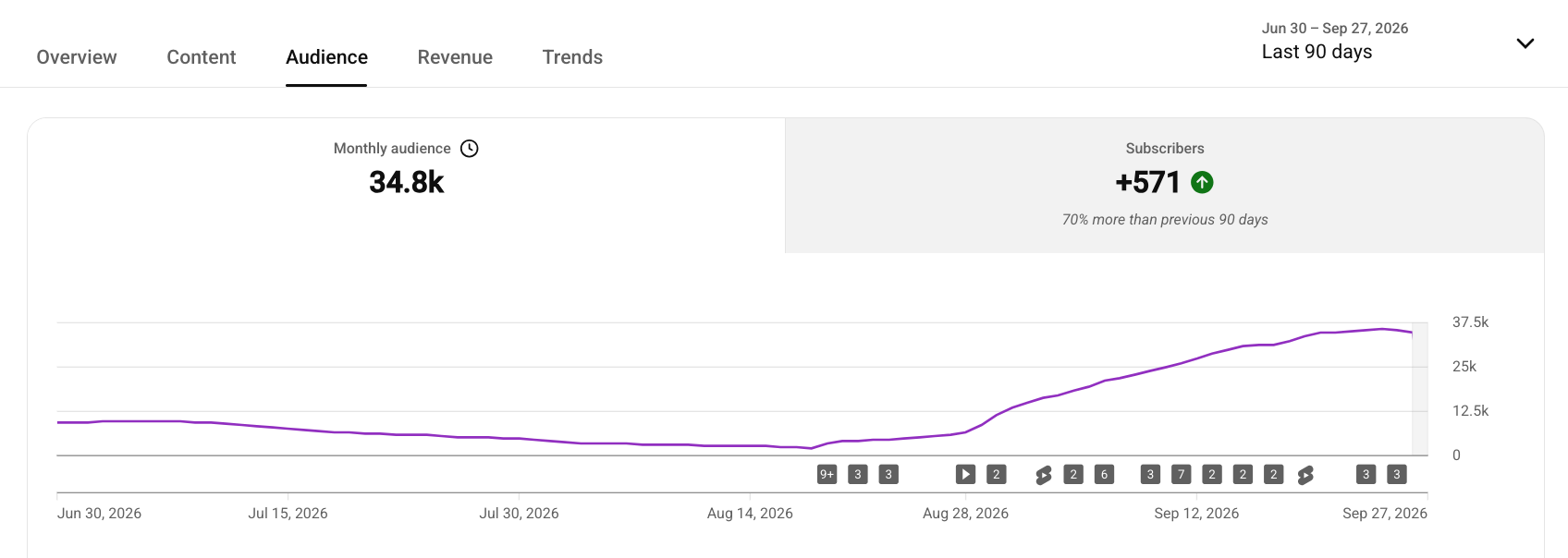
Five weeks after restarting: 34.8k monthly viewers and +571 subscribers.
We are obviously not talking about millions of views and we are nowhere near being a huge YouTube channel, but for a small independent publisher, the change was significant enough to make us pay attention.
More interesting than the headline numbers, though, was what started happening underneath them. Older films began resurfacing, shorter book pieces were finding completely new audiences, and longer films about what we were actually doing started giving people a route into Soi that felt much more natural than simply landing on a product page.
For the first time in a while, the channel felt alive again.
And, perhaps more importantly, it now has some shape.
We have started building a few repeatable formats rather than treating every upload as a one-off. Books Worth Looking At is one of those. At the moment it is very simple: a top-down camera, a book on the table and us looking through some of the rarer, stranger or more interesting art and design books from our archive. No huge production, just a chance to slow down and talk about why a particular book matters, what it does well and what we can learn from it.
Alongside that, we have started organising the older documentaries and short films that were made long before Soi looked like it does now. A lot of those films were intrinsic to the way we think about publishing today, so rather than burying them as old content, we are beginning to treat them as part of the story.
Then there is the newer series around actually building an independent publishing studio.
The first episode followed the launch of True World Skate, from the build-up through to the event itself. The second took us to Glue at the ICA, where we shared a table with Velocity Press, met readers, sold some books and got to see the slightly unglamorous reality of what an art book fair actually feels like from behind the table.
That format is probably the one we are most excited about because it gives us somewhere to put all the things that do not fit neatly into a finished book or a polished Instagram post. The uncertainty, the long timelines, the people, the travel, the things that go wrong, the moments that suddenly make a project feel real.
In other words, the channel is starting to look less like a marketing exercise and more like an extension of the publishing itself.
That is probably the biggest thing we have learned from restarting it.